
Carbon Cycling in Hadal Zones
Tectonically-triggered sediment and carbon export to the Hadal zone
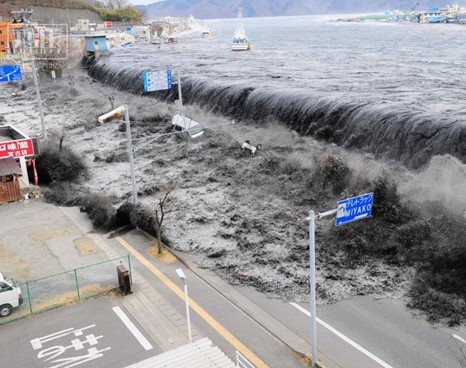
Sediments in deep ocean trenches may contain crucial information on past earthquake history and constitute important sites of carbon burial. We found that the 14C data on bulk organic carbon (OC) and its thermal decomposition fractions produced by ramped pyrolysis/oxidation for a core retrieved from the >7.5 km-deep Japan Trench. High-resolution 14C measurements, coupled with distinctive thermogram characteristics of OC, reveal hemipelagic sedimentation interrupted by episodic deposition of pre-aged OC in the trench. Low δ13C values and diverse 14C ages of thermal fractions imply that the latter material originates from the adjacent margin, and the co-occurrence of pre-aged OC with intervals corresponding to known earthquake events implies tectonically triggered, gravity-flow-driven supply. We show that 14C ages of thermal fractions can yield valuable chronological constraints on sedimentary sequences. Our findings shed new light on links between tectonically driven sedimentological processes and marine carbon cycling, with implications for carbon dynamics in hadal environments.
Reference:
Bao, R., Strasser, M., McNichol, A. P., Haghipour, N., McIntyre, C., Wefer, G., & Eglinton, T. I. (2018). Tectonically-triggered sediment and carbon export to the Hadal zone. Nature Communications 9, 121. https://doi.org/10.1038/s41467-017-02504-1
Earthquake-enhanced dissolved carbon cycles in ultra-deep ocean sediments
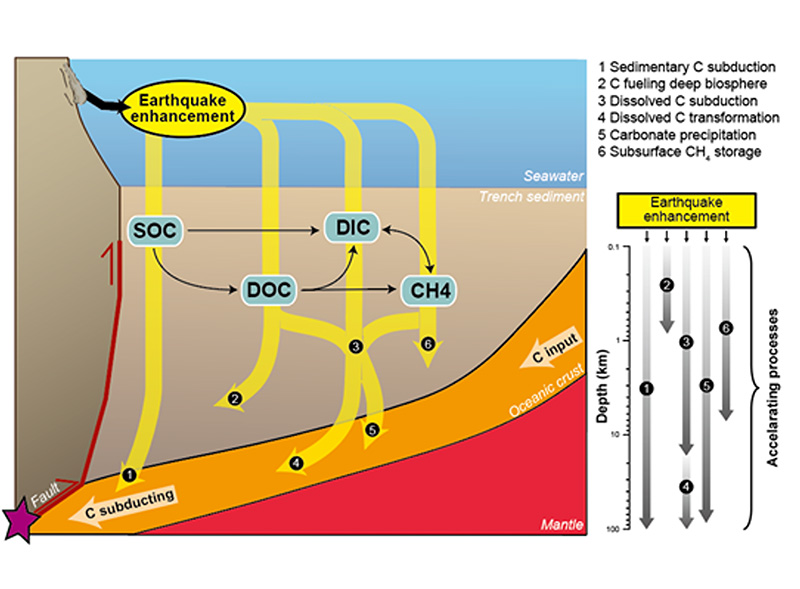
Hadal trenches are unique geological and ecological systems located along subduction zones. Earthquake-triggered turbidites act as efficient transport pathways of organic carbon (OC), yet remineralization and transformation of OC in these systems are not comprehensively understood. Here we measure concentrations and stable- and radiocarbon isotope signatures of dissolved organic and inorganic carbon (DOC, DIC) in the subsurface sediment interstitial water along the Japan Trench axis collected during the IODP Expedition 386. We find accumulation and aging of DOC and DIC in the subsurface sediments, which we interpret as enhanced production of labile dissolved carbon owing to earthquake-triggered turbidites, which supports intensive microbial methanogenesis in the trench sediments. The residual dissolved carbon accumulates in deep subsurface sediments and may continue to fuel the deep biosphere. Tectonic events can therefore enhance carbon accumulation and stimulate carbon transformation in plate convergent trench systems, which may accelerate carbon export into the subduction zones.
Reference:
Chu, M., Bao, R.*, Strasser, M., Ikehara, K., Everest, J., Maeda, L., Hochmuth, K., Xu, L., McNichol, A., IODP 386 scientists. (2023). Earthquake-enhanced dissolved carbon cycles in ultra-deep ocean sediments. Nature Communications 14, 5427. https://doi.org/10.1038/s41467-023-41116-w
Earthquake-induced redistribution and reburial of microbes in the hadal trenches
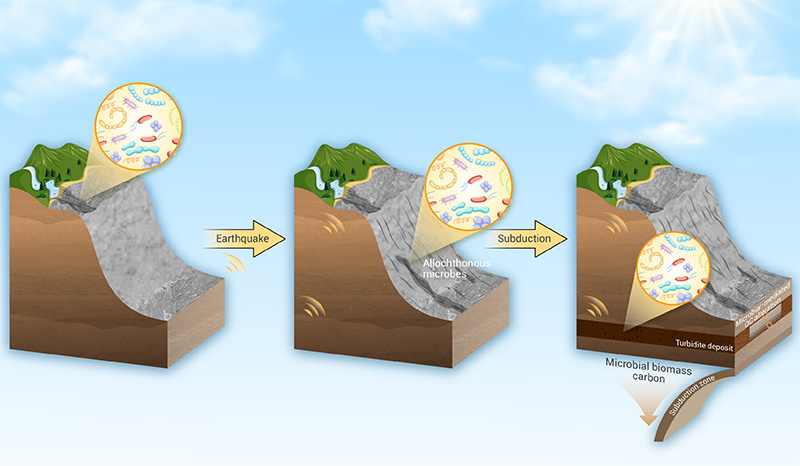
Here we demonstrate that distinctive allochthonous microbial communities are introduced into the Japan Trench by three historical earthquakes, with community structure transitions observed across the turbidite boundaries. The variations of the microbial community structures are linked to earthquake-driven organic carbon deposition and its characteristics, suggesting the potential impact of mass transport events on the microbial-mediated deep carbon cycles. Our calculations indicate that the Pacific trenches receive at least 5.1 Pg of earthquake-induced microbial biomass carbon during the past century, with spatial and temporal variations at different scales. These results suggest that pulsed tectonic events play a crucial role in introducing allochthonous microbes to the deep biosphere, potentially leading to substantial microbial biomass carbon export into the subduction zone.
Reference:
Chu M., Liu J., Li H., Zhou Y., Wang N., Xia C., Kopf A., Strasser M., & Bao R.*(2023). Earthquake-induced redistribution and reburial of microbes in the hadal trenches. The Innovation Geoscience, 1(2), 100027. https://doi.org/10.59717/j.xinn-geo.2023.100027
Removal of Dissolved Organic Carbon in the West Pacific Hadal Zone
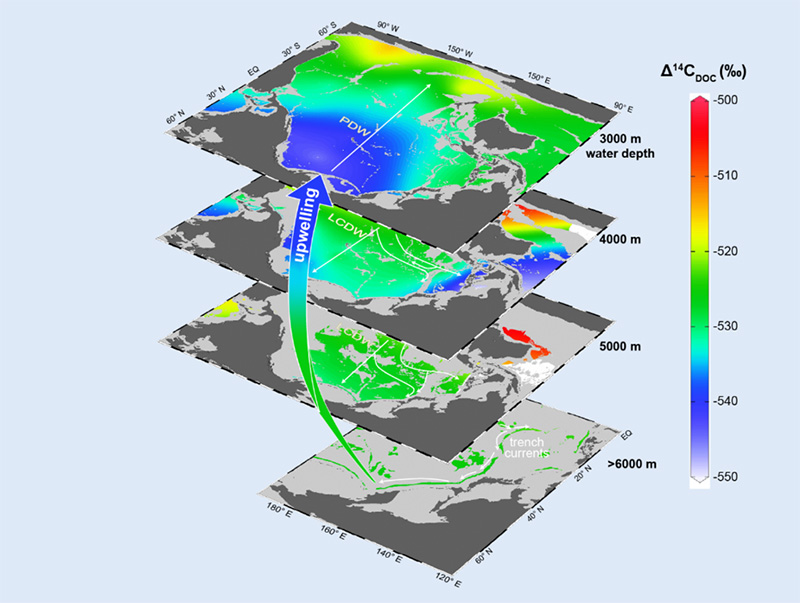
The deep oceans are environments of complex carbon dynamics that have the potential to significantly impact the global carbon cycle. However, the role of hadal zones, particularly hadal trenches (water depth > 6 km), in the oceanic dissolved organic carbon (DOC) cycle is not thoroughly investigated. Here we report distinct DOC signatures in the Japan Trench bottom water. Here we found that up to 1/3 of the Pacific deep-sea dissolved organic carbon (DOC) is removed from the dissolved carbon pool in the Japan Trench. The DOC removal in the hadal environment is potentially related to earthquake-triggered physical and biogeochemical processes, which highlight a potential coupling between the marine carbon cycle and tectonic activity. Based on a cross-ocean-basin radiocarbon analysis, we proposed that the Pacific hadal zones are critical sinks in the global DOC cycle.
Reference:
Chu, M., Bao, R.*, Strasser, M. et al. (2025). Removal of dissolved organic carbon in the West Pacific hadal zones. Nature Communications 16, 733. https://doi.org/10.1038/s41467-025-55883-1
Sediment-modulated seafloor residence time controls efficient organic carbon burial in subduction zones.
The subduction organic carbon (OC) flux is closely linked with seafloor sedimentation processes.In hadal trenches, sediment transport and resuspension caused by turbidity events provide rapid feedback of subducting carbon fate to seafloor sedimentation dynamics. Here we demonstrate that sediment sorting creates distinct OC burial patterns in the Japan Trench: Prolonged seafloor residence enables preferential removal of labile OC components and result in a refractory subsurface OC pool. Conversely, rapid sediment burial shortens seafloor residence time and promotes subsurface anaerobic OC degradation. We further suggest that these mechanisms result in at least 37.5% loss of the OC subduction flux in accretionary margins due to early diagenetic and thermal alteration processes, while erosive margins only loss 11% during subduction and preferentially transfer thermally stable OC into subduction zones. Our work bridges surficial depositional regimes and deep carbon transfer, highlighting the need to consider depositional settings when refining subduction zone carbon budgets.
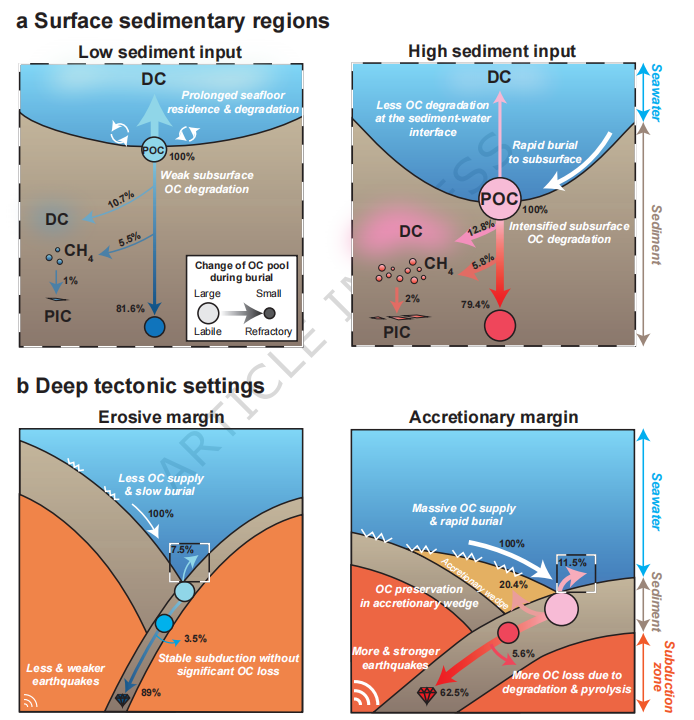
Conceptual model illustrating the organic carbon (OC) degradation, pyrolysis and subduction from the seafloor to subduction zone.
Reference:
Chu, M., Liu, K., Cai, Z., Rasbury, T., Kölling, M., Zabel, M., McHugh, C., Strasser, M., Ikehara, K., & Bao, R. (2026). Sediment-modulated seafloor residence time controls efficient organic carbon burial in subduction zones. Nature Communications. https://doi.org/10.1038/s41467-026-72049-9