




• Shi, J., Li, Y., Zhao, J., Leng, S., Bao, R., Aihara, K., Chen, L., & Lin, W. (2026). The Innovation, 101358. https://doi.org/10.1016/j.xinn.2026.101358
Abstract: Detecting and quantifying causal influence is a focal topic in the fields of science, engineering, and interdisciplinary studies. However, causal studies on non-intervention systems attract much attention but remain extremely challenging. Delay-embedding technique provides a promising approach. In this study, we propose a framework named Interventional Dynamical Causality (IntDC) in contrast to the traditional Constructive Dynamical Causality (ConDC). ConDC, including Granger causality, transfer entropy and convergence of cross-mapping, measures the causality by constructing a dynamical model without considering interventions. A computational criterion, Interventional Embedding Entropy (IEE), is proposed to measure causal strengths in an interventional manner. IEE is an intervened causal information flow but in the delay-embedding space. Further, the IEE theoretically and numerically enables the deciphering of IntDC solely from observational (non-interventional) time-series data, without requiring any knowledge of dynamical models or real interventions in the considered system. In particular, IEE can be applied to rank causal effects according to their importance and construct causal networks from data. We conducted numerical experiments on Logistic dynamics, coupled-He ́non maps, and chaotic neural networks to demonstrate that IEE can find causal edges accurately, eliminate effects of confounding, and quantify causal strength robustly over traditional indices. We also applied IEE to real-world tasks, including estimating neural connectomes of C. elegans, detecting COVID-19 transmission networks in Japan, and investigating regulatory networks surrounding key circadian genes. IEE performed as an accurate and robust tool for causal analyses solely from the observational data. Both the IntDC framework and the IEE algorithm proposed in this study provide an approach to understanding causal influence in diverse non-intervention complex systems.
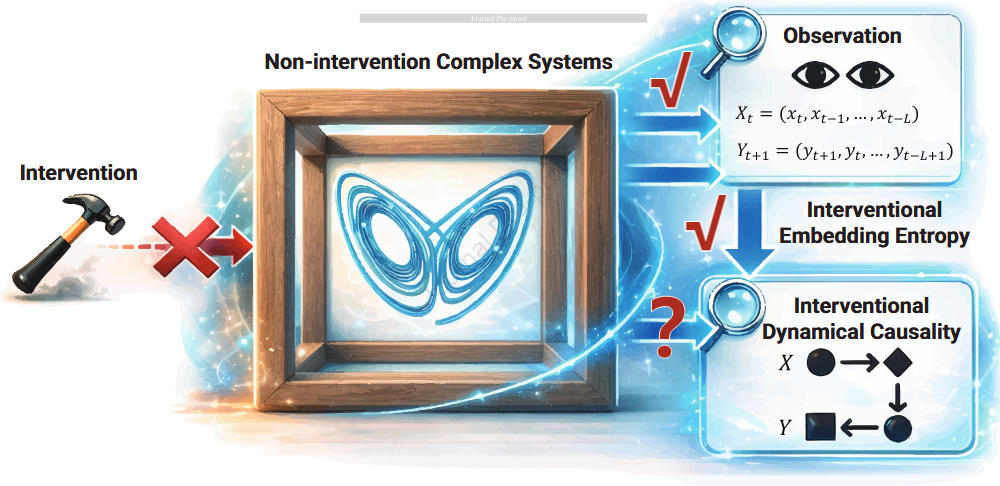
graphical abstract
Citation: Shi, J., Li, Y., Zhao, J., Leng, S., Bao, R., Aihara, K., Chen, L., & Lin, W. (2026). Deciphering interventional dynamical causality from non-intervention complex systems. The Innovation, 101358. https://doi.org/10.1016/j.xinn.2026.101358