


• Wang, K., Wang, Y.*, Yue, Q., Zhang, X., Liu, J., Xiao, C., Kanamatsu, T., Strasser, M., & Bao, R. (2025). Deep Sea Research Part I: Oceanographic Research Papers, 217, 104455. https://doi.org/10.1016/j.dsr.2025.104455
Abstract: Understanding the properties of trench sediments is an important aspect of comprehending the sources and transport variations of trench sediments. This study seeks to identify the sources of sediment and understand the mechanisms driving sediment source variation in the Challenger Deep, based on the environmental magnetic characteristics and geochemical properties of the MT20-750 core retrieved from a depth of 10,815 m in the Mariana Trench. The proximal sediment source of the MT20-750 core comprises mainly altered bedrock com ponents from the southern Pacific Plate and volcanic eruption materials from the northern Philippine Plate, while the distal source is primarily aeolian dust input, with biogenic materials also contributing. The overall magnetic susceptibility values of the sediments in the Challenger Deep are significantly higher, reaching 3–5 times that of other regions in the Pacific Ocean. The strong magnetic properties of these sediments are primarily due to the enhanced alteration of the southern subducting plate rocks, which are mainly composed of basalt rich in iron and magnesium (mafic basalt), under the action of Pacific bottom water. This represents a normal state when sed iments are funneled into the trench axis and preserved in an oxidizing environment. However, the sediments from the northern Philippine Sea Plate, mainly composed of tuffaceous rocks with lower Fe, Mg, and Ti content, intermittently enter the trench during seismic events or turbidity flows. These events alter the sediment composition in the trench, leading to a decrease in magnetic susceptibility values, with the change in provenance primarily driven by the varying intensity of geological processes and the specific conditions of sediment transport.
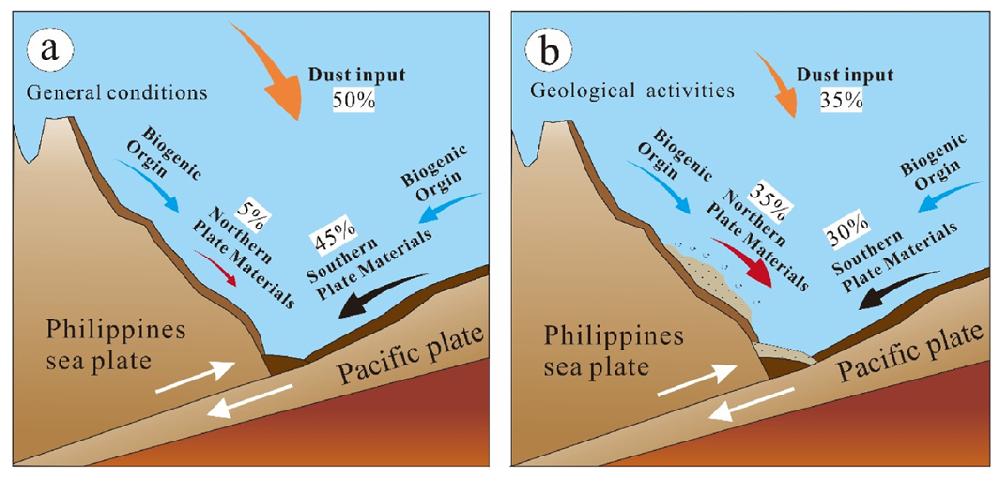
Sedimentation Patterns in the MT20-750 Sediment Core from the Challenger Deep. The Pacific Plate acts as the underlying plate, while the Philippine Sea Plate is the overlying plate. (a) Sediment supply is predominantly from the Pacific Plate, as seen in Section B layer. (b) Material input from the Philippine Sea Plate increases in Section A layer, with event deposition occurring in certain sections (e.g., Section A0).
Citation: Wang, K., Wang, Y.*, Yue, Q., Zhang, X., Liu, J., Xiao, C., Kanamatsu, T., Strasser, M., & Bao, R. (2025). Strong magnetism and geochemical characteristics of sediment in challenger deep and their indications for sources. Deep Sea Research Part I: Oceanographic Research Papers, 217, 104455. https://doi.org/10.1016/j.dsr.2025.104455